Related Course: Introduction to Algorithm ¶ 6:46 PM 0 comments


Beta Function
Related Course: Calculus, Statistics ¶ 9:50 PM 0 comments
Rational and Irrational numbers
Lemma 1
- Between any two different rational numbers a and b there is at least one other rational number.
- Between any two different irrational numbers a and b there is at least one other rational number.
- Between any two different rational numbers a and b there is at least one other irrational number.
- Between any two different irrational numbers a and b there is at least one other irrational number.
Corollary
In all four statements assertion of existence of a single number can be replaced with the assertion of existence of infinitely many numbers.
Lemma 2
Union of two countable sets is countable.
Lemma 3
Union of a countable number of countable sets is countable.
Lemma 4
The set Q of all rational numbers is equivalent to the set N of all integers.
Lemma 5
The set I of all irrational numbers is not countable.
Lemma 6
The set of all algebraic numbers is countable.
¶ 1:41 PM 0 comments
Probability is often taken too seriously. When someone hears that the probability of a given event occurring is zero, the usual interpretation is that the event will never occure. In other words, it is commonly thought that an event with a probability of zero is impossible.
However, take, for instance, the set of all integers. What is the probabilty of choosing a given integer at random? Since there are an infinite number of integers and we are choosing only one, we would the calculate the probability as being 1/infinity = 0.* But this means that we have zero probability of choosing any given number. That's perplexing, because if we choose a random number from the set of integers we will have just accomplished something that has a probability of zero!
Even more perplexing, the rational numbers are a countable subset of the uncountable set of real number. (The uncountably infinite set of irrational numbers are what makes the real numbers uncountable.) In other words, there are infinitely more irrational numbers than rational numbers. That means the probabiliy of choosing a rational number at random out of the set of real numbers is zero!
.....
Related course: Probability
The expression "Monte Carlo method" is actually very general. Monte Carlo (MC) methods are stochastic techniques--meaning they are based on the use of random numbers and probability statistics to investigate problems. You can find MC methods used in everything from economics to nuclear physics to regulating the flow of traffic. Of course the way they are applied varies widely from field to field, and there are dozens of subsets of MC even within chemistry. But, strictly speaking, to call something a "Monte Carlo" experiment, all you need to do is use random numbers to examine some problem.
The use of MC methods to model physical problems allows us to examine more complex systems than we otherwise can. Solving equations which describe the interactions between two atoms is fairly simple; solving the same equations for hundreds or thousands of atoms is impossible. With MC methods, a large system can be sampled in a number of random configurations, and that data can be used to describe the system as a whole.
"Hit and miss" integration is the simplest type of MC method to understand, and it is the type of experiment used in this lab to determine the HCl/DCl energy level population distribution. Before discussing the lab, however, we will begin with a simple geometric MC experiment which calculates the value of pi based on a "hit and miss" integration.Related Courses: Digital Electronics, Probability, Statistics ¶ 11:07 AM 1 comments
The expression "Monte Carlo method" is actually very general. Monte Carlo (MC) methods are stochastic techniques--meaning they are based on the use of random numbers and probability statistics to investigate problems. You can find MC methods used in everything from economics to nuclear physics to regulating the flow of traffic. Of course the way they are applied varies widely from field to field, and there are dozens of subsets of MC even within chemistry. But, strictly speaking, to call something a "Monte Carlo" experiment, all you need to do is use random numbers to examine some problem.
The use of MC methods to model physical problems allows us to examine more complex systems than we otherwise can. Solving equations which describe the interactions between two atoms is fairly simple; solving the same equations for hundreds or thousands of atoms is impossible. With MC methods, a large system can be sampled in a number of random configurations, and that data can be used to describe the system as a whole.
"Hit and miss" integration is the simplest type of MC method to understand, and it is the type of experiment used in this lab to determine the HCl/DCl energy level population distribution. Before discussing the lab, however, we will begin with a simple geometric MC experiment which calculates the value of pi based on a "hit and miss" integration.Related Courses: Digital Electronics, Probability, Statistics ¶ 11:07 AM 0 comments
Related Course: Introduction to Biotechnology ¶ 11:40 PM 0 comments

"Bacteria belonging to the family Deinococcaceae are some of the most radiation-resistant organisms yet discovered. Deinococcus (Micrococcus) radiodurans strain R1 (ATCC BAA-816) was first reported in 1956 by A. W. Anderson and coworkers of the Oregon Agricultural Experimental Station, Corvalis, Oregon. This obligate aerobic bacterium typically grows in rich medium as clusters of two cells (diplococci) in the early stages of growth, and as clusters of four cells (tetracocci) in the late stages of growth, is non-pathogenic, and best known for its ability to survive extremely high doses of acute ionizing radiation (10,000 Gy) without cell-killing. For comparison, 5 Gy is lethal to the average human, and 1,000 Gy can sterilize a culture of Escherichia coli. D. radiodurans is capable of growth under chronic radiation (60 Gy/hour) and resistant to other DNA damaging conditions including exposure to desiccation, UV light, and hydrogen peroxide. The genes and cellular pathways underlying the survival strategies of D. radiodurans are under investigation, and its resistance characteristics are being exploited in the development of bioremediation processes for cleanup of highly radioactive US Department of Energy waste sites."
Related Course: Introduction to Biotechnology ¶ 11:33 PM 0 comments
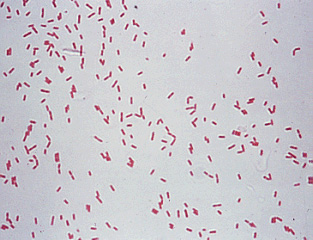
"Pseudomonas aeruginosa is the epitome of an opportunistic pathogen of humans. The bacterium almost never infects uncompromised tissues, yet there is hardly any tissue that it cannot infect if the tissue defenses are compromised in some manner.
Pseudomonas aeruginosa is a Gram-negative, aerobic rod belonging to the bacterial family Pseudomonadaceae. The family includes other genera, which, together with certain other organisms, constitute the bacteria informally known as pseudomonads. These bacteria are common inhabitants of soil and water. They occur regularly on the surfaces of plants and occassionally on the surfaces of animals. The pseudomonads are well known to plant microbiologists because they are one of the few groups of bacteria that are true pathogens of plants. In fact, Pseudomonas aeruginosa is occasionally a pathogen of plants. But Pseudomonas aeruginosa and two former Pseudomonas species (now reclassified as Burkholderia) are pathogens of humans. A general treatment of the pseudomonads is presented in The Genus Pseudomonas . This chapter deals specifically with Pseudomonas aeruginosa as a pathogen of humans.
Pseudomonas aeruginosa is an opportunistic pathogen, meaning that it exploits some break in the host defenses to initiate an infection. It causes urinary tract infections, respiratory system infections, dermatitis, soft tissue infections, bacteremia, bone and joint infections, gastrointestinal infections and a variety of systemic infections, particularly in patients with severe burns and in cancer and AIDS patients who are immunosuppressed. Pseudomonas aeruginosa infection is a serious problem in patients hospitalized with cancer, cystic fibrosis, and burns. The case fatality rate in these patients is 50 percent."
Related Course: Introduction to Biotechnology ¶ 11:30 PM 0 comments

Epulopiscium fishelsoni - a visible species of microbes
"Epulopiscium fishelsoni was first found in the gut of the brown surgeonfish Acanthurus nigrofuscus in the Red Sea in 1985. Since then, similar organisms have been found in surgeonfish in the Hawaiian Islands, French Polynesia, Tuvalu, Guam, southern Japan, Papua New Guinea, the Great Barrier Reef, and South Africa (Bresler et al. 1998). Due to the daily cycle of the E. fishelsoni, it affects the pH of the surgeonfish's gut fluids differently during the day and night which suggests that cyclic metabolic changes occur within the bacterium."
Related Course: Introduction to biotechnology ¶ 11:23 PM 0 comments
Uncountable Set - Wikipedia
Related Course: Discrete Mathematics & Probability ¶ 4:17 PM 0 comments
-Wall- All of the above `-W' options combined. This enables all the warnings about constructions that some users consider questionable, and that are easy to avoid (or modify to prevent the warning), even in conjunction with macros. This also enables some language-specific warnings described in C++ Dialect Options and Objective-C and Objective-C++ Dialect Options.
-c- Compile or assemble the source files, but do not link. The linking stage simply is not done. The ultimate output is in the form of an object file for each source file.
By default, the object file name for a source file is made by replacing the suffix `.c', `.i', `.s', etc., with `.o'.
Unrecognized input files, not requiring compilation or assembly, are ignored.

